¶ The Principles of Body Fat
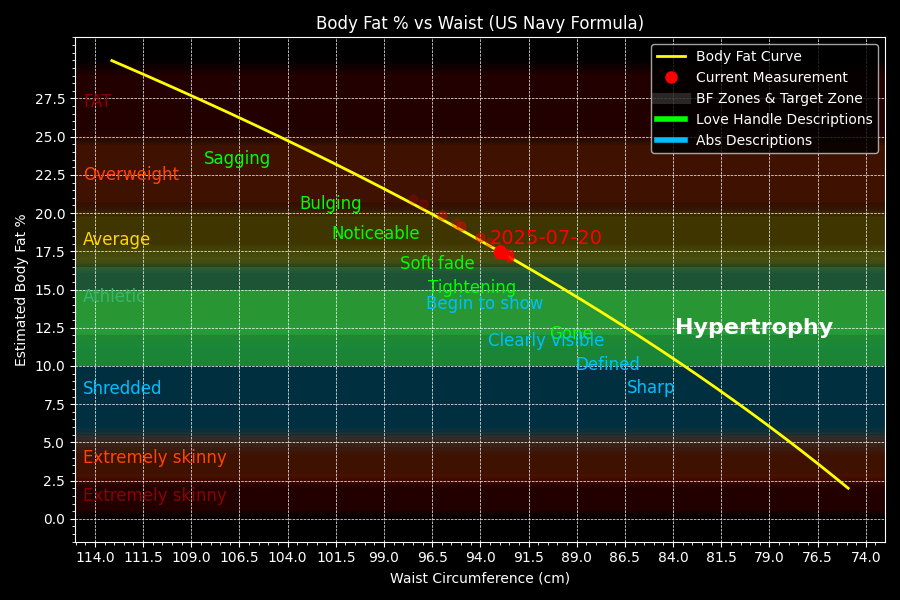
Body fat is stored energy. It accumulates when you eat more energy than you burn. Some fat is essential — it cushions organs, supports hormones, and helps absorb vitamins — but excess fat impacts health and appearance.
¶ The Role Food Plays
Food is the primary factor in determining whether we gain or lose fat.
It is the fuel our body runs on.
Food serves two purposes:
- Building and repairing the body (especially muscle tissue)
- Providing energy to operate the body
For building tissue (like muscle), the key macronutrient is protein.
For energy, we rely on carbohydrates (sugar) and fats.
They are not fully interchangeable, though the body can adapt to some degree.
Let’s keep things very simple for this introduction.
¶ The 3 Macronutrients:
- Protein – essential for tissue repair and muscle growth.
→ Eat plenty. Higher intake is generally beneficial for body composition. - Carbs – fuel for muscles and brain.
→ Especially important for training performance and recovery. - Fat – energy source and critical for hormone production, brain health, and fat-soluble vitamins.
| Nutrient | Too Little | Too Much |
|---|---|---|
| Protein | loss of Muscle, slow recovery, weak immune system, constant hunger | Rarely harmful, but excess may strain digestion and displace carbs/fats |
| Fat | Hormonal disruption (testosterone, estrogen), dry skin, brain fog, cold hands, Obsession with nut butters, cheese, or fried foods | Easy fat gain (especially with carbs), bloating, inflammation, low energy |
| Carbs | Low training performance, brain fog, sugar cravings, poor digestion | Insulin spikes, water retention, blood sugar crashes, belly fat gain |
| Calories | Fatigue, mood swings, sleep issues, stalled metabolism, muscle loss | Body fat accumulation, poor sleep, hormonal imbalance, metabolic slowdown |
¶ 📏 Estimating Body Fat
Body fat scales?
Most smart scales rely on Bioelectrical Impedance, which can be skewed by your hydration, when you last ate, or even if your feet are dry. You can fluctuate 2–4% just from that.
🚫 No. They are unreliable because they measure electrical impedance, which fluctuates with hydration, salt intake, and timing.
✅ Instead, use the U.S. Military Circumference Method — simple, surprisingly accurate, and requires only a tape measure.
¶ 📐 Equipment
- Flexible measuring tape or string
- Your height
You only need to update your waist regularly — height and neck don’t change.
Take measurements in the morning, relaxed, before food or training.
Do two measurements and use the average.
-> Neck needs to be remeasured every couple weeks
¶ 👤 Measuring (Men)
- Height – in cm or inches
- Neck – just below the Adam’s apple
- Waist – at the narrowest point (typically near the navel)
¶ 📎 Formula:
Metric (cm):
%BF = 495 / (1.0324 − 0.19077 × log10(Waist − Neck) + 0.15456 × log10(Height)) − 450
Imperial (in):
%BF = 86.010 × log10(Waist − Neck) − 70.041 × log10(Height) + 36.76
The simplified version omits the final subtraction for body fat %, but the full equation is more accurate.
Neck changes slowly, so it doesn’t need frequent updates.
¶ 👩 Measuring (Women)
Same as for men, plus:
- Hips – at the widest point
¶ 📎 Formula:
Metric (cm):
%BF = 495 / (1.29579 − 0.35004 × log10(Waist + Hip − Neck) + 0.22100 × log10(Height)) − 450
Imperial (in):
%BF = 163.205 × log10(Waist + Hip − Neck) − 97.684 × log10(Height) − 78.387
¶ 🔥 Losing Fat
Bad news:
Fat is usually lost in reverse order of how it was gained.
- You first gain fat in the abdomen, then arms and legs.
- When losing fat, you first trim in the extremities, then the belly.
That’s why early fat loss can result in a “skinny fat” look — lean arms/legs, soft core.
Good News:
Losing fat is actually very simple and straightforward. The issue is not that its hard to understand. The issue is our psyche.
Straight Forward, its an energy game: How much energy are you putting into your body and how much is it consuming?
You can find that out by checking your calorie intake vs your body fat.
Fat goes up? -> you need less calories
Fat goes down? -> good
Muscle goes down? -> you are probably eating too little protein and you're cutting calories too far Your body enters emergency(starvation) mode. You probably have gnawing hunger at this point. (warning signal)
¶ 💪 Recomposition
If you're new to training, **losing fat while building muscle is absolutely possible.
This is called body recomposition — and it improves both appearance and metabolic health.
¶ 📉 How Fast to Lose Fat?
You must:
- Track your calorie intake
- Measure your body fat every 1–2 weeks
- Measure your weight
This allows you to answer:
- Am I losing fat or just water/muscle?
- Am I actually gaining or even losing muscle?
- Am I stuck or making progress?
- What is my real maintenance calorie level?
It is best if you stay in a reasonable zone below your calorie intake in order for you to see progress. But not feel like starving and falling to your cravings.
This chart shows early recomposition tracking from Jun 8 to Jun 25. While intake fluctuated, the body fat trend provided feedback on what worked — helping calibrate actual calorie needs.
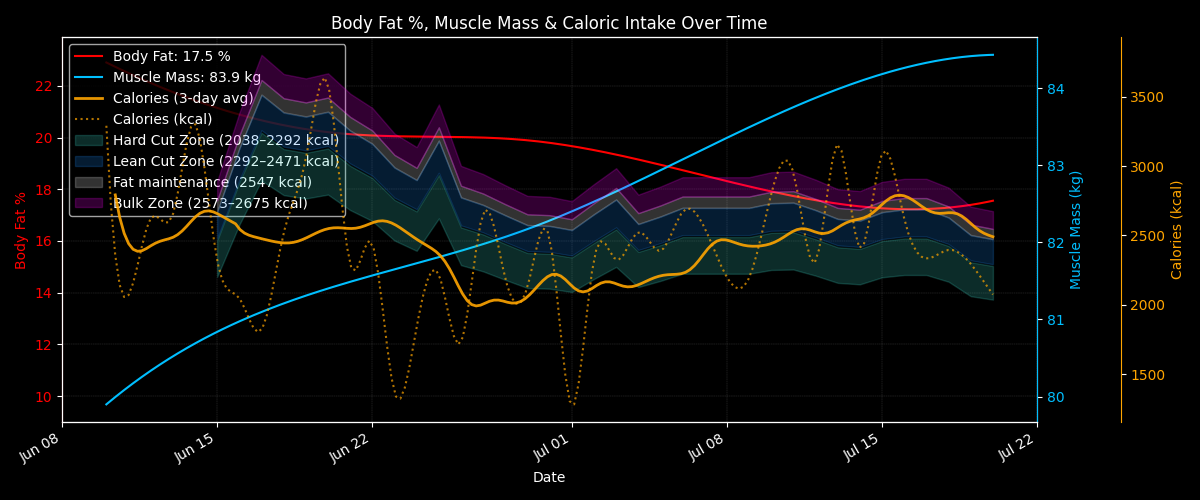
It can be tough at times to keep the caloric intake steady, or on target, which is why the yellow line is prominent. It’s a rolling average of caloric intake, used to smooth day-to-day variance.
¶ 🏆 Tips for Fat Loss Success
You don’t need perfection — you need consistency, feedback, and course correction.
✅ 1. Prioritize Protein Every Meal
It keeps you full, protects your muscle, and supports fat loss.
Build meals around protein — not carbs or fat.
📏 2. Track Your Food Honestly
Don’t guess. Don’t “forget” the snacks.
Even rough estimates are better than self-deception.
⚖️ 3. Measure Body Fat + Weight Weekly
Use a tape measure for accuracy.
Don’t panic over scale fluctuations — look for fat trends, not water.
🍽️ 4. Keep Meals Simple and Repeatable
You don’t need a new recipe every day.
A few staple meals you enjoy = less decision fatigue, more success.
💧 5. Eat Enough — But Not Too Much
Undereating will backfire. Overeating keeps you stuck.
Stay just slightly below maintenance — enough to lose fat, not your sanity.
🧠 6. Cravings? Diagnose the Cause
Ask: Am I low on protein, fat, carbs, or just calories overall?
Then fix the deficit — not with snacks, but with real food.
🔁 7. Be Flexible, Not Lazy
Missed a day? Get back on track immediately.
You’re not fragile — but you are human. Plan for that.
💪 8. Train Hard and Recover Well
Use your body — muscles are fuel-hungry.
More muscle = higher metabolism = easier fat loss.
📊 9. Review Every 2 Weeks
Are you progressing? If not: adjust calories, check sleep/stress, fix protein.
Course correction is success — not failure.
🛑 10. Don’t Chase Fat Loss Forever
Cutting too long burns muscle, tanks energy, and fries your mood.
Take breaks. Refeed. Shift into maintenance or recomp when needed.